Median Home Price by US State in 2026
If you have tried to look for a house lately, you already probably know the golden rule of real estate hasn’t changed: location, location, location. What has changed is how far your dollar will stretch depending on which side of a state border you stand on. In 2026, the nationwide bidding wars of the early 2020s had cooled down, which paved the way for a highly fragmented market.
In some states, a surge in new construction has finally triggered a price drop. In others, however, certain factors, such as low inventory, keep competition fierce.
But what other factors determine property prices in each US state? Let’s split the states into two categories: high-demand and low-demand. California, New York, and Florida, for example, attract new residents with their booming job markets and weather. West Virginia and Mississippi, on the other hand, belong to the latter category, with lower incomes and fewer high-paying jobs, among other things, dictating the relatively low (in comparison with other states) real estate prices.
If you are wondering about the prices of properties in your state or want to know where your budget can buy you a backyard, read on for the complete 2026 state-by-state breakdown of median house prices.
Average vs. Median Home Price: What Is the Difference?
Most home prices by state rankings use median home prices rather than averages, because the median better represents what a typical home costs. It’s important to understand the difference before you start comparing data across states.
The average home price is the total of all home prices divided by homes sold. The median home price is the middle value of homes sold, meaning half sold for more and half sold for less. Median price is not affected by outliers in home values, which is why analysts prefer it. In states like California and New York, a handful of multimillion-dollar sales can pull the average upward dramatically, while the median stays anchored closer to what most buyers actually pay.
Here is a quick example: imagine a coastal market where five homes sell for $300K, $350K, $400K, $500K, and $4,000,000. The average sale price is $1,110,000, but the median is just $400K. The average is nearly three times higher because of a single luxury sale. This is exactly why median figures are more useful for most buyers.
What It Costs to Buy a Home Across America This Year
Check the table below to see state-by-state median single-family home prices (provided by Forbes Advisor). The results are not available for North Dakota and Wyoming.
States with the Highest Median Home Prices
The highest median home prices are concentrated in a handful of coastal and high-demand markets. These states typically share common traits: strong job bases, limited land, and strict zoning rules that restrict new buildings.
Here is a breakdown of the most expensive markets in the United States (single-family home prices).
California
California has the highest median home price among the 50 states at $854,000. The homeownership rate in the state is 55.3%. Strong technology and finance sectors lead to higher home values in the state.
In the Bay Area and coastal metros, expect prices far above that figure. San Francisco and San Jose, for example, push well beyond the statewide figure.
The structural reasons are well-documented: a powerful tech and entertainment economy, geographic constraints (coastline, mountains), strict local zoning, and decades of underbuilding that keep housing supply tight. The result is that California also faces one of the highest homelessness rates.
Hawaii
Hawaii’s median home price is $773,400. Homeownership sits at around 60.9%, according to USAFacts, and high costs extend to utilities, insurance, and transportation. Housing desirability is influenced by climate, geographic features, and amenities, all of which Hawaii offers in abundance.
Washington, D.C.
Washington, D.C. has a median home price of $676,500 for single-family homes. The District’s homeownership rate is 40.3%, reflecting its dense urban character and rental-heavy market.
Massachusetts
Massachusetts’s median home price is $645,400. The state is the global hub for biotech, life sciences, healthcare, and robotics, alongside massive finance and higher education sectors. The homeownership rate in the state stands at 62.4%. In fact, the state is no longer just a tourism and agricultural economy. Instead, it has evolved into one of the country’s most knowledge-intensive economies.
Colorado
In the state of Colorado, the median home price stands at $604,600. Its mix of 300 days of sunshine, world-class outdoor recreation, and a progressive cultural scene has drawn hundreds of thousands of new residents over the last decade. The Front Range has transformed into a massive aerospace, tech, defense, and clean-energy hub. In addition, the state has a homeownership rate of 62.9%.
States with the Lowest Median Home Prices
Many of the lowest median home prices in the US are found in the Midwest and parts of the South, where land is more abundant, construction faces fewer regulatory hurdles, and job markets are less concentrated in a few superstar cities.
Here are several of the least expensive states:
Iowa
Iowa has the lowest median home price at $250,700, making it one of the cheapest statewide markets. The homeownership rate in the state is 70.2%. The thing is that, unlike Hawaii (surrounded by the ocean), Colorado (blocked by mountains), or Massachusetts (densely built out and coastal), Iowa has vast, flat, and accessible land. The abundance of buildable land keeps the raw cost of land low, which prevents the artificial scarcity that drives up prices elsewhere.
West Virginia
The beautiful state located in the Appalachian region of the Southern United States has a median home price of $253,300. Its homeownership rate, however, is the highest in the country — 78.1%. But there are reasons that make the state one of the most affordable areas in the US. Historically, West Virginia’s economy relied heavily on traditional industries like coal mining, manufacturing, and agriculture. As those sectors contracted over the decades, the state didn’t experience the massive influx of high-paying tech or corporate jobs in other parts of the country, which has kept housing demand and prices modest.
Oklahoma
Oklahoma’s median home price stands at $256,700, and its homeownership rate is 63.8%. But why does the state rank as one of the most affordable? Major cities like Oklahoma City and Tulsa are not hemmed in by oceans or mountains. Also, because the raw supply of buildable land is basically unlimited, the cost of land remains quite low. In addition, building permits in the state are issued rather quickly, and the minimal red tape allows homebuilders to quickly reach market demand, with new construction swiftly flowing into the market.
Louisiana
$260,300 is the median home price in the state, with the homeownership rate being 69.3%. One of the reasons for such a relatively low median residence price is slower population growth. Unlike states in the Mountain West or parts of the Sunbelt that have seen massive rates of incoming residents, Louisiana has experienced stagnant population growth and even net out-migration over the last decade.
Ohio
In Ohio, the typical home value is $262,900. The homeownership rate in the state stands at 70.3%. There are a few reasons for the state’s relatively low median house price. Some of them are a massive supply of older housing stock, geographic accessibility, and high property taxes (it frequently ranks in the top 10 to 15 states for high property tax rates).
Home Affordability by State: Prices vs. Incomes
Home affordability is not just about house prices. It depends heavily on local incomes and mortgage rates, typically measured by how many years of income it would take to buy a median-priced home. Home prices are influenced by supply and demand dynamics, but so is the money residents have available to spend.
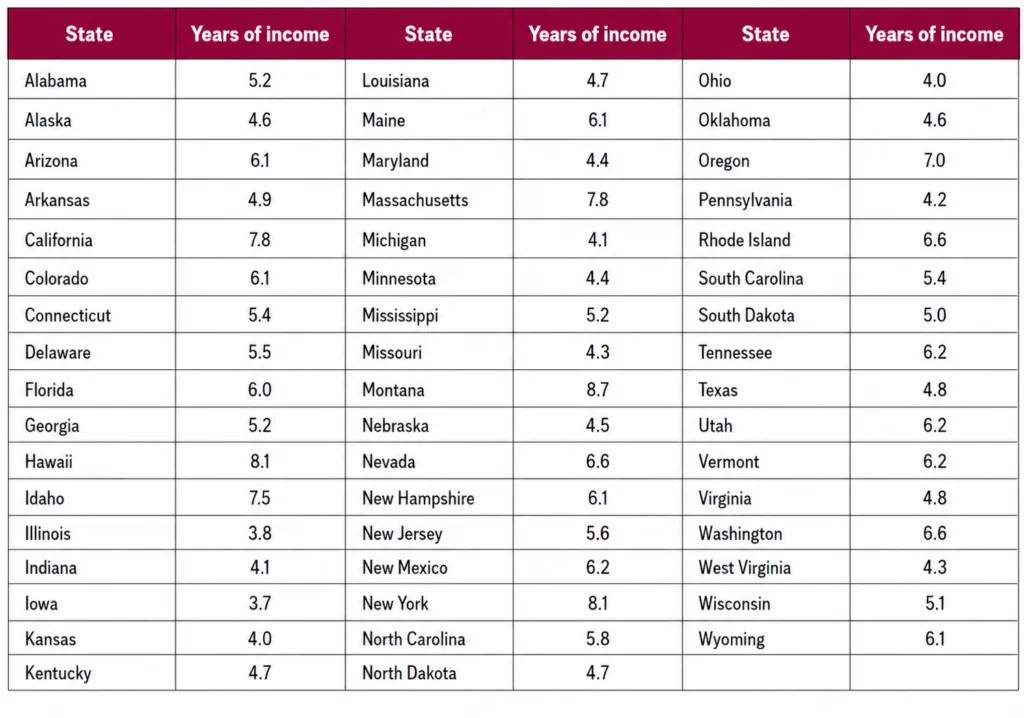
In some states like Montana and Idaho, home prices have climbed so fast that they now require more years of income than historically expensive states like California, particularly after pandemic-era migration drove up demand. The “years of income to buy a home” metric, calculated by dividing the median home price by the median household income, reveals whether housing costs are outpacing earnings across the country.
Sun Belt states like Texas and Florida have seen affordability deteriorate, even though their home prices remain below the most expensive coastal states. The Midwest, on the other hand, including Iowa, Ohio, Indiana, Kansas, and Illinois, stands out as an affordability stronghold, where a typical home often costs 3 to 4 years of income instead of 7 to 9. In addition, states with slightly lower prices but also low wages can still feel unaffordable, which is why looking at price alone does not tell the whole story.
How Many Years of Income to Afford a Home in Each US State?
Using median home prices and median household incomes, you can estimate how many years of gross income are needed to purchase a typical home in each state. This gives a quick snapshot of home affordability differences.
See the table below with the information provided by the Visual Capitalist to find out how many years of gross median household income it takes to cover the cost of a typical home in each U.S. state
Strategies to Improve Home Affordability
You cannot control median home prices, but you can take concrete steps to lower your personal housing costs and improve home affordability. Here’s how:
- Strengthen your credit score. Even a modest improvement can help you qualify for competitive rates, which reduces monthly mortgage payments, especially in high-cost states.
- Compare multiple mortgage offers. Shop across loan types: conventional, FHA, and VA. Each has different down payment requirements and rate structures. Minor fluctuations in fixed mortgage rates heavily impact buyer purchasing power, so locking in the best rate matters.
- Target slightly smaller homes or adjacent neighborhoods. Using Rew Online, you can check similar properties in the area that may have smaller differences. In addition, on this real estate intelligence platform, you can find a property’s price, condition, occupancy status, and other details that will help you find high-potential real estate opportunities.
- Increase your down payment if possible. A larger down payment reduces your loan amount, cuts interest costs, and helps you avoid private mortgage insurance, which adds to monthly expenses.
- Time your purchase strategically. Competition and prices are often slightly lower in late fall and winter, when fewer buyers are active.
Frequently Asked Questions
Which state officially has the most expensive homes in 2026?
California and Hawaii constantly battle for the number one spot, with median home prices sitting at $854,000 and $773,400, respectively. Hawaii’s island geography creates a natural land shortage, while California’s massive tech and coastal economies continue to pull prices sky-high.
Why do median home prices vary so much by US state?
Housing prices depend on local demand, population growth, job market, and land availability. States that have strong tech or finance industries tend to have higher real estate prices. On the other hand, rural or less densely populated areas are the ones that are more affordable.
Why do some states with lower home prices still feel unaffordable to locals?
Because looking at the sticker price of a house only tells half the story. States like Louisiana and Mississippi boast low baseline real estate prices, but they also have lower median household incomes and high localized costs like homeowner insurance. Affordability is all about the gap between a house’s price and how much a person earns.
Does remote work affect home prices across states?
Yes, remote work has actually increased demand in previously lower-cost states. The thing is, buyers are moving away from expensive urban hubs in search of affordability. This, however, has caused price growth in suburban and rural markets.
What factors could change housing price trends?
Inflation, job market changes, or mortgage rate cuts can quickly affect prices. Natural disasters and insurance costs are also increasingly influential.
The post Median Home Price by US State in 2026 appeared first on Real Estate Weekly.