Buying a House Without Seeing It in Person? Here’s What to Know
When one buys a home, they usually come to see the property, walk through every room, and try to get a feel of the neighborhood before making a final decision. However, it’s not always possible for homebuyers to physically be present at the place they want to purchase, and that’s where remote home buying comes in.
In fact, advances in technology have made the process of purchasing a house without even seeing it in person a piece of cake. This was especially a thing during the pandemic in 2020, when 63% of homebuyers acquired properties without viewing them in person. And who can blame them? High-quality video tours and 3D walkthroughs make everything look realistic.
However, despite simplicity, purchasing a home remotely has its challenges. That’s why certain essential steps need to be taken before committing to the idea. Prior to making an offer from a distance, it’s important to understand all the strategies and risks.
Is Buying a Home Sight Unseen Right for You?
If you’re having a hard time deciding whether making an offer on a home without an in-person visit is for you, we’ve prepared some of the pros and cons of this decision.
You may be a good candidate if you:
- Are moving on a tight timeline (starting a new job in another country or state soon)
- Already have familiarity with the city or neighborhood after visiting before
- Are comfortable with technology and flexible enough to accept mild surprises
- Are an investor focused on numbers more than emotional feel
You should be cautious if you:
- Are a first-time buyer with no local support or friends in the area
- Are highly detail-sensitive, easily bothered by smells, textures, or noise that virtual tours can’t reveal
- Are pushing the top of your budget with no room for unexpected repair costs
Steps to Take When You Want to Buy a Property You Can’t See in Person
In this section, you’ll find the relevant tips that will help you make a property-purchasing decision without stepping foot on the property.
Research the Area
To take a look at the area, it would be a good idea to “see” the neighborhood virtually since you can’t be there in person.
Start with Google Maps, Google Street View, and satellite view. Check proximity to major roads, rail lines, airports, and industrial sites. Research neighborhood noise sources like highways or airports that could create constant disruption. “Walk” the block virtually at different zoom levels, looking for red flags such as boarded-up homes, heavy on-street parking, or obvious drainage issues.
To get a precise idea about the neighbors, visit Rew Online, a reverse address lookup platform. It gathers all the important information about a property and the neighborhood where it’s located, including median land area, construction year, number of bedrooms and bathrooms, and much more. When it comes to the neighbors, you’ll be able to find their names, phone numbers and emails, ages, property details, and other things.
Choose a Good Real Estate Agent
When you buy a house without seeing it, a good real estate agent becomes your stand-in at every step, so it’s wise to choose someone professional.
Questions to ask your real estate agent:
- How many home sight unseen transactions did you close in the last 12–24 months?
- What technology do you use for remote showings (FaceTime, Zoom, WhatsApp, 3D tours)?
- How do you document issues: video walk-throughs, annotated photos, written summaries?
A truly good real estate agent for remote buyers will point out flaws on camera without hesitation, measure rooms live, know local building quirks (like 1950s slab foundations or 1980s polybutylene plumbing), and be responsive across time zones.
Prepare Your Financing and Offer Strategy
In competitive real estate markets, buyers who intend to buy a house sight unseen must be financially prepared to move fast.
If you’d like to move with a mortgage, get preapproved for it before making an offer. The preapproval process means collecting W-2s, pay stubs, bank statements, and credit reports, then obtaining a full preapproval letter from a lender stating a specific price range. This isn’t the same as prequalification. For a sight unseen offer, preapproval is especially crucial because it reassures sellers who may be nervous about accepting an offer from someone far away.
Earnest money typically runs 1–3% of the purchase price, held in escrow. Under most contingency failures (inspection, financing, appraisal), the buyer gets it back. Make sure to discuss your maximum budget, walk-away points, and risk tolerance with your agent in advance.
Virtually Tour Your Potential Dream Home
Virtual touring gives more than scrolling through listing photos. It’s a deliberate process that’s designed to replace your physical senses when buying a house you’ve never seen in real life.
How a live video tour should work:
- Agent on site with a phone or tablet, buyer watching via a video call
- Buyer directs the pace, requesting close-ups of windows, ceilings, under sinks, behind doors, and other places of the property
- A buyer asks real-time questions in the moment instead of relying on photos or a pre-recorded video
Remember that static photos and staged 3D tours aren’t enough on their own. They often hide flaws such as street noise when windows are open, uneven floors, or dark corners.
If possible, ask a friend, colleague, or family member in the area to attend the tour with the agent and share their own sense of the space afterward. It’s also a good idea to request unedited video clips and extra photos of anything borderline so you can rewatch calmly after the live call ends.
Protect Yourself with Inspections, Disclosures, and Contingencies
In the absence of in-person visits, a thorough home inspection and a well-written contract become the main safety net for buyers.
A standard home inspection covers structure, roof, electrical, plumbing, HVAC, major appliances, and safety issues. Inspectors can identify issues like foundation problems and moisture damage that cameras simply won’t catch. Hire an inspector who regularly works with out-of-town or home sight unseen clients. Redfin’s guide to common inspection problems shows the most frequently flagged issues include structural damage, roof problems, and plumbing failures.
Closing Remotely on a House You’ve Never Visited
In many U.S. states, the entire closing process for purchasing a home can now be handled remotely. As of early 2025, 45 states plus D.C. have permanent laws authorizing remote online notarization.
Between inspection and closing, you’ll negotiate repairs or credits, lock your mortgage rate, receive the final Closing Disclosure, and schedule signing. Options for remote signing include fully online e-closings, hybrid closings where most documents are signed digitally with a few notarized in person, and mobile notary services that visit your current home or office.
A detailed remote final walk-through is non-negotiable. Your agent should be on site with live video, comparing the current condition to the inspection report, verifying that the agreed-upon repairs were completed, and confirming the property is empty and clean.
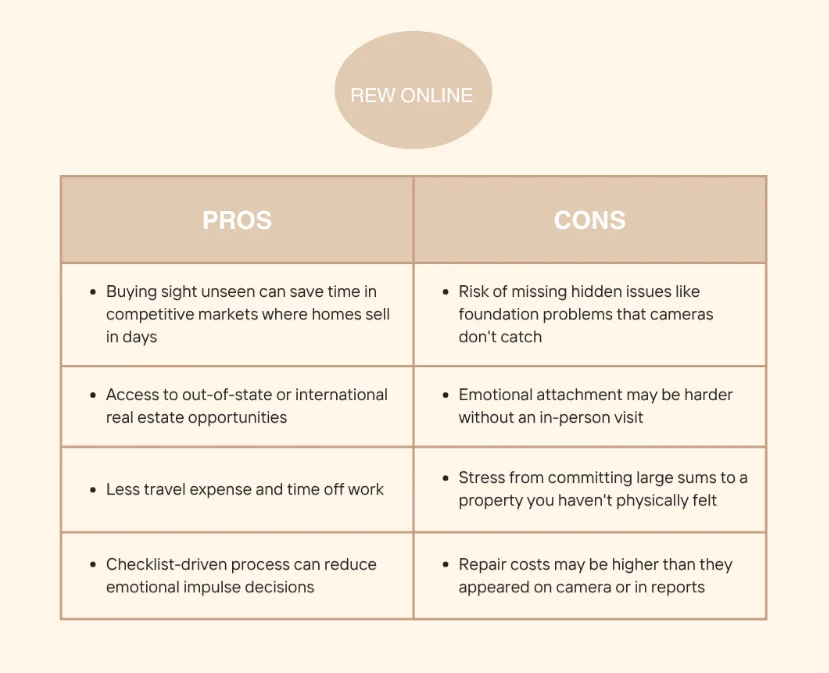
Pros and Cons of Buying a House Without an In-Person Visit
Even with smart planning, buying a house sight unseen has real trade-offs.
Let’s Recap
For some people, purchasing a property without physically seeing it seems like a risky adventure. But reality shows that thanks to the right strategies, it has become a practical and increasingly common choice for modern buyers. Technology has made the process of remote home buying pretty easy, but the key to pulling it off smoothly isn’t just staring at pretty 3D tours and calling it a day.
Researching the area, working with a professional and reliable real estate agent, preparing financially, taking a virtual tour around the property, and conducting a thorough home inspection are effective strategies remote homebuyers rely on for a successful deal closure.
Frequently Asked Questions
Is it legal to buy a house without seeing it first?
Yes. In the U.S. and many other countries, there’s no law requiring buyers to physically visit a property before purchasing it. Contracts and disclosures govern the transaction, not in-person visits. Lenders and title companies are comfortable with home sight unseen deals as long as standard appraisals, inspections, and identification checks are completed.
Can I back out if I finally see the home and don’t like it?
Backing out depends on what contingencies are in the contract. Inspection, appraisal, and financing contingencies are the most common exit routes. Some buyers negotiate a special “sight unseen” clause or tie their obligation to a satisfactory final walk-through, but this must be written into the purchase agreement from the start. Canceling without a valid contractual reason can cost you your earnest money deposit, so always consult your agent or attorney before withdrawing.
What is a sight-unseen addendum?
It’s a legally binding rider attached to a real estate purchase contract or lease agreement. It’s used when a buyer submits an offer without being physically present at the property. Its primary purpose is liability protection for sellers while establishing clear expectations for the homebuyer.
How do property taxes and insurance work when buying from out of state?
Property taxes and homeowners insurance are calculated based on the home’s specific address, not where you currently live. However, if you’re buying a property as an investment or second home rather than your primary residence, your mortgage interest rate, insurance premiums, and property tax rates may be higher.
The post Buying a House Without Seeing It in Person? Here’s What to Know appeared first on Real Estate Weekly.