Fed Holds Rates at 3.75%–4% as Inflation and Mortgage Rates Remain in Focus
The Fed’s decision to hold rates is only one part of the story. Chair Kevin Warsh used his press conference to lay out how he sees inflation, growth and the forces shaping future policy—and to signal that he won’t promise what the committee will do next. For mortgage professionals, the remarks on market rates, oil and the Fed’s mortgage-backed securities portfolio deserve particular attention.
Matt Sexton’s live coverage, published Oct. 28, 2026, followed the Fed’s Wednesday announcement and press conference. The blog has ended, but the policy questions it raised remain open.
Inflation kept rates on hold
The Fed maintained its federal funds target at 3.75% to 4%. Warsh said economic activity was expanding at a strong pace, but inflation had remained above the Fed’s objective for close to six years. Price stability, he said, dominated the committee’s discussions.
He pointed to an improving growth picture: first-half GDP was revised up to 2.4% from 1.8%, third-quarter growth appeared faster, consumer spending was running above 3%, and business investment was increasing at roughly a double-digit pace. Warsh also described labor-market indicators as healthy, citing a lower jobless rate than a year earlier, faster payroll growth than last year and unemployment claims at their lowest level in generations.
That combination helps explain the hold: the economy showed strength, while inflation remained unresolved. Warsh said the Fed had reinforced its 2% target after he arrived five months earlier, but acknowledged the committee had not yet achieved price stability.
No promise about December
Warsh declined to preview the next rate decision, due in about six weeks. He said he doesn’t favor forward guidance in ordinary times, particularly when the real economy is strong, and doesn’t want to prejudge future meetings. He described forward guidance as useful during the worst days of the 2008 financial crisis, but said current conditions don’t warrant it.
The market was still pricing in a likely increase: CME FedWatch showed a 76.5% probability, as of Wednesday morning, of a federal funds rate 25 basis points above the current level after the December meeting. The Fed’s September projections had also indicated another increase this year. Warsh’s message was that neither signal settles the matter; he said the committee would have more information by the next meeting.
Strategy gets space on the calendar
The Fed plans to reserve some meetings for longer-term policy discussions. Beginning in 2027, one of its eight annual meetings will focus on broad monetary strategy, with no rate vote or policy statement expected. The other seven meetings that year will remain policy-setting sessions. In 2028, Warsh expects six policy meetings and two devoted to strategy.
He argued that the meeting schedule shapes the quality of the committee’s decisions, giving policymakers time both to respond to current conditions and to reconsider larger questions. Warsh did not identify which 2027 meeting would be set aside.
Rates reach beyond housing
Warsh rejected the notion that investment in artificial intelligence is insulated from higher interest rates. “Interest rates get in the cracks,” he said, arguing that borrowing costs affect almost everything directly or indirectly. He pointed to investors becoming more selective since early September, with credit spreads widening for some assets and financial conditions tightening somewhat.
He also questioned the idea that AI alone explains the economy’s strength. Warsh said capital spending had broadened, making it harder to describe growth as confined to a few narrow pockets. The Fed’s stated aim, he added, isn’t to force a slowdown or push people out of work; he sees tighter financial conditions as the main way policy is taking effect, and said those conditions had tightened somewhat since the previous meeting.
Oil, market yields and mortgage rates
Warsh described a strong relationship between rising oil prices and market-set interest rates earlier in the year. More recently, market rates had turned lower even as oil remained elevated, which he attributed largely to geopolitical events and a wide gap between crude and refined products. He declined to speculate about how a future drop in oil would affect Fed policy, saying officials would need to assess its effects on inflation, employment and financial markets.
There’s a useful mortgage-market reference point here: Freddie Mac’s average 30-year rate slipped to 7.32% on Oct. 22, from 7.40% a week earlier. The 10-year Treasury yield had also eased after reaching 5.36% on Oct. 7. Warsh cautioned against treating oil as a simple policy signal, while noting that futures prices had risen over the preceding several weeks.
Balance-sheet review still underway
Recommendations from the Fed’s Balance Sheet Task Force are expected to reach the committee early next year, though Warsh cautioned that the timing wasn’t firm. Asked how further balance-sheet reductions might affect foreign holders of Treasuries, he said the task force was still comparing proposals. He said any changes would follow careful consideration and were unlikely to have a material effect on policy under current conditions.
The Fed also holds mortgage-backed securities, a part of the balance sheet with direct relevance to mortgage markets, though Warsh did not address them in that answer. He said some, but not all, of the five task forces he established may meet their year-end deadlines. The Productivity and Jobs Task Force plans a field hearing on Nov. 16, which Warsh expects to attend; he said it would run three to four hours and examine whether productivity growth could accelerate quickly or emerge gradually.
More reaction to come
The live blog closed at 3:50 p.m. ET. Fergal McAlinden was due to publish an interview the following day with Melissa Cohn of William Raveis Mortgage, and had also spoken with Kristin O’Neil of Open Door Lending about the decision to hold rates. Liezel Once gathered reaction from across the mortgage industry. The next live blog was scheduled for Dec. 9.
Sexton also shared a quick video report on the meeting.
Warsh sees inflation risks despite improving activity
Kevin Warsh’s message was a study in competing signals: economic activity is improving, but inflation remains too high. “Real activity is clearly pointing in the right direction,” he said, adding that energy and related prices had risen again in recent weeks. The Fed’s task, he said, is to prevent those increases from spreading through the wider economy.
Warsh said financial and credit conditions had tightened for some businesses and households since the Fed’s September rate increase, as policymakers expected. Investors, too, are being more selective about where they put capital. But he stopped short of calling conditions tight: “While overall financial conditions are tighter, I'm unwilling and unable to call them tight.”
Five months into his tenure as chair, Warsh said uncertainty hadn’t weakened the committee’s commitment to stable prices. He said policymakers were ready to respond as needed, and that incoming data would help them decide where rates should go next.
Warsh’s comments and lender reaction
2:28 p.m. ET
Warsh’s remarks were set to air on YouTube, with notable comments to be transcribed as the event unfolded. Readers were also invited to weigh in on the Fed’s decision in a LinkedIn poll.
VOTE NOW: Did the Fed get it right? Vote in our poll now!
Lender view: The tone may matter more than the hold
2:25 p.m. ET
For Charles Goodwin, vice president of investor mortgage sales at Kiavi, the signal in Warsh’s press conference could outweigh the rate decision itself. He said markets had already priced in a hike in either October or December. A hold paired with hawkish language, he warned, could push mortgage rates higher than a hold delivered with a softer message.
Goodwin said a hawkish tone could keep 30-year mortgage rates in the mid-7% range or send them higher. A softer tone, perhaps acknowledging a weaker jobs report, could instead bring a relief rally in Treasury yields. The distinction matters for borrowers, but the outcome is uncertain: consumer confidence is weakening as inflation worries meet a softer labor market.
In private lending, Goodwin said, rental-to-own (RTL) loan volumes tend to track existing-home sales, so higher rates usually slow housing activity and reduce lending volume. Professional real estate investors have held up well, however, and RTL volumes have seen little impact. Debt-service coverage ratio (DSCR) loans have also gained ground against traditional financing for investment properties; Goodwin expects that demand to remain strong.
Schwab expects a December move and a divided housing market
2:20 p.m. ET
Omar Aguilar, CEO and chief investment officer of Schwab Asset Management, expected the Fed to pause and take its next step in December. Speaking with Mortgage Professional America at Schwab IMPACT 2026 in Boston, he said policymakers would want to see whether oil prices become less of a concern heading into 2027. He anticipated two more increases before another pause, saying CPI and PPI readings likely gave the Fed enough support for a December move.
Aguilar sees housing splitting along the same lines as the broader economy. In San Francisco and Texas, newly public companies have created wealth, and some buyers can purchase without a mortgage. Those markets, he said, are heating up despite mortgage rates. At the other end, first-time and newer buyers face less construction and fewer opportunities to purchase.
“Yes, at 7%, mortgage rates, it's very hard,” Aguilar said. Owners with 2% to 3% mortgages have little incentive to sell, further restricting inventory. That squeeze makes the weaker side of the market particularly difficult for brokers: mortgage originations are under pressure, and the labor market remains a key variable. Aguilar described employment as stable for now.
Byline Bank sees little urgency, but inflation remains the concern
2:15 p.m. ET
Kurt Funderburg, chief investment officer of Byline Bank, said the Fed’s pause came as no surprise. Recent comments from policymakers, he said, suggested little appetite to move immediately, even though the committee still sees inflation as a priority. At the September meeting, 16 of 18 participants projected at least one more rate hike in 2026.
Funderburg said the debate is whether inflation is spreading broadly or remains concentrated in supply pressures such as oil and other commodities from the Middle East. Investment in AI infrastructure adds another question: whether the boom is pushing up demand and prices. He planned to watch Warsh’s tone, any dissent, the statement’s wording and the bond market’s response.
Mortgage rates will follow the data and bond market
2:10 p.m. ET
The Fed has made its decision; now the bond market will shape the mortgage-rate outlook over the coming weeks. Ryan Hayes, head of retail sales at Chase Home Lending, expects rates to stay near their recent range, with frequent swings as inflation and labor data arrive. A Fed decision doesn’t translate directly into an equal mortgage-rate move, he said, because markets often price in expectations well before policymakers act.
After a recent retreat from October highs, Hayes expects rates to remain volatile in the near term. Cooling data could bring modest declines, but borrowers should be ready for sharp reactions to economic releases and shifts in investor risk appetite. Inflation expectations, the midterm elections and new bond supply could also move Treasury yields. Hayes singled out borrowing by large AI hyperscalers as a possible source of competition for investor demand.
For brokers and loan originators, Erik Schmitt, head of consumer direct sales at Chase Home Lending, said the focus should be finding a loan that fits each borrower. The right choice depends on the buyer’s goals, he said, with an affordable, sustainable monthly payment as the main priority. Buyers may have more options than they expect, including low-down-payment loans, grants and discounts.
Two Fed officials voted to raise rates
2:07 p.m. ET
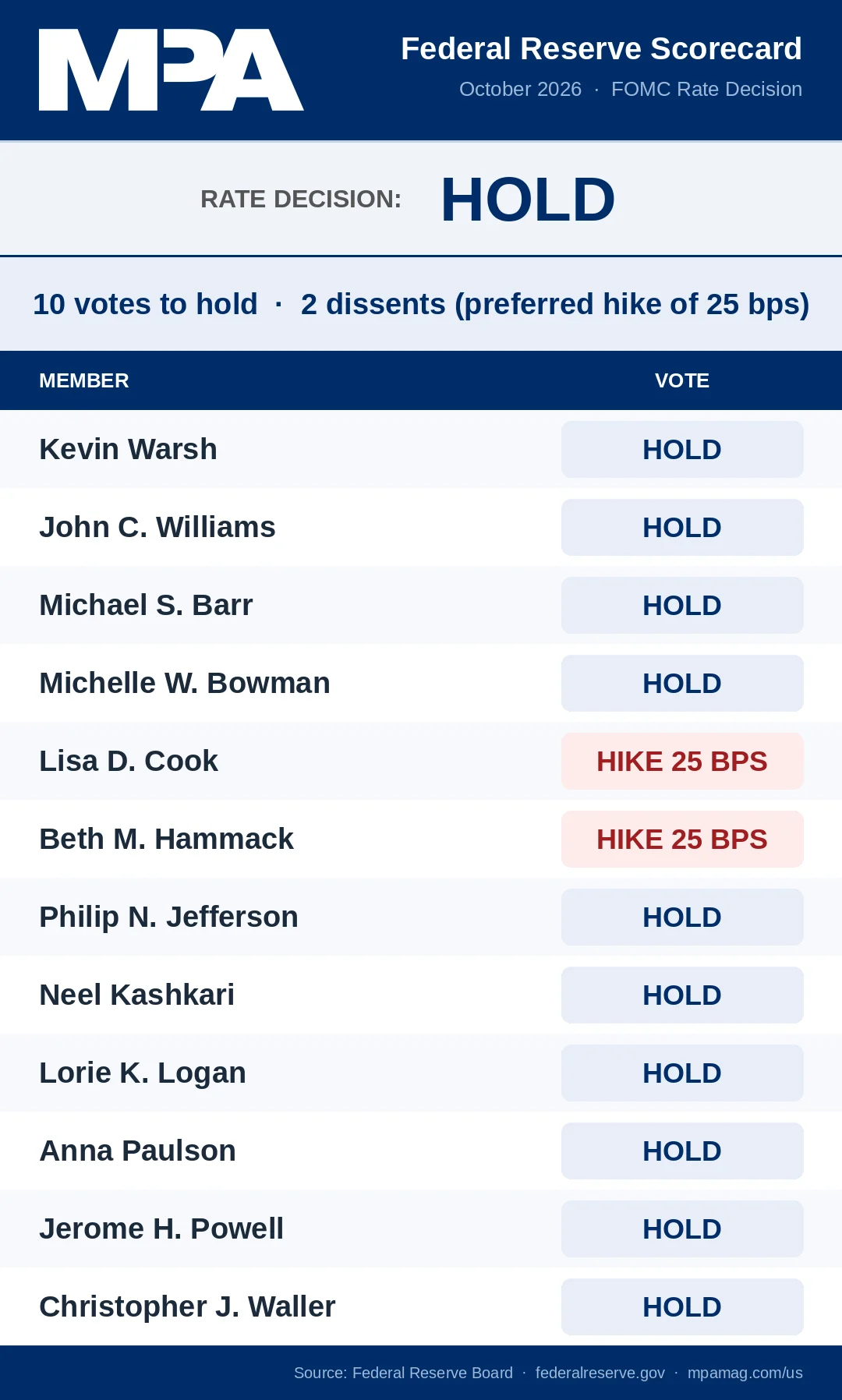
The decision to hold rates was 10-2. Lisa Cook and Beth Hammack dissented, voting instead for a 25-basis-point increase.
See the chart below for the vote breakdown:
The Fed holds its target rate at 3.75% to 4.00%
2:00 p.m. ET
The Federal Reserve kept its federal funds target range unchanged at 3.75% to 4.00% on Wednesday. That followed a 25-basis-point increase at the previous meeting. Cook and Hammack voted for another quarter-point hike, leaving the decision at 10-2.
Warsh was scheduled to discuss the decision at 2:30 p.m. ET.
Mortgage professionals expected a pause
1:50 p.m. ET
Most mortgage professionals expected the Fed to leave rates unchanged. Jay Lessard, president of Sonoran Lending, told Mortgage Professional America that the accompanying language—and what it signaled about December—would matter more than the announcement itself.
Lessard said the Fed still faced pressure on both sides of its mandate. Inflation remained too high for policymakers to claim victory, while slower hiring and a softer economy gave them reason to wait rather than raise rates at every meeting. For mortgage markets, he said, the bond market’s reading of the Fed’s future plans may matter more than the rate decision. He expected a bumpy couple of days.
Jessica Eddy, a loan officer at Edge Home Finance, also expected a hold. She said traders were assigning a 75% chance to a quarter-point hike in December, and warned that Warsh’s remarks could stir volatility. The federal funds rate isn’t the mortgage rate, Eddy said; the 10-year Treasury is a closer guide to mortgage pricing.
The Fed’s decision was due at the top of the hour.
Bank of Canada raises its rate by a quarter point
1:40 p.m. ET
The Bank of Canada raised its overnight rate target by 25 basis points to 2.5% on Wednesday, its first increase since July 2023. The Bank Rate moved to 2.75%, and the deposit rate to 2.45%.
Governor Tiff Macklem pointed to higher energy costs amid a war in the Middle East that had entered its eighth month, with no clear resolution in sight. The inflation outlook had worsened since the Bank’s July report. “With the war in the Middle East persisting, global oil prices have increased and are expected to remain higher for longer,” Macklem said. He said the increase was raising costs at the pump and for businesses.
Inflation had stayed near 3% since April, and the Bank expected it to reach about 3.5% by year-end. Excluding gasoline, September inflation was 2.2%. Canada’s economy had also been stronger than expected, with second-quarter GDP rising 3.3%, although the Bank expected housing to remain relatively weak.
The policy choice pitted core inflation near 2%, economic slack and new US tariffs in favor of holding rates against the risk that higher energy costs would spread through the economy. Macklem said the rate increase was intended to reduce that risk. The Bank left open the possibility of further hikes, saying it would decide one meeting at a time; its next rate decision was scheduled for Dec. 9.
Weinberg criticizes the Fed’s dual mandate
1:30 p.m. ET
Glen Weinberg, COO and partner at Fairview Commercial Lending, has spent more than 30 years in the industry and is known for forceful views on mortgage policy. He argued that asking the Fed to pursue both employment and stable prices makes its job harder. “This dual mandate was the worst thing the Federal Reserve could do,” Weinberg told Mortgage Professional America. His view puts the tension between inflation and employment at the center of the debate over the Fed’s next move.
The Fed’s dual mandate is becoming a point of contention. Congress amended the Federal Reserve Act in 1977 to direct the central bank to pursue maximum employment, stable prices and moderate long-term interest rates. Weinberg argues that, in practice, the Fed should concentrate on inflation. That’s a consequential stance: the jobs data can affect rate decisions, but it’s often revised after publication.
Weinberg said the Fed would likely be considering another rate increase if a weaker jobs report hadn’t appeared a few weeks earlier. He sees that as evidence that employment concerns are pulling the central bank away from inflation control. “Employment should have nothing to do with their decisions,” he said, arguing that the Fed should focus on inflation and the economy’s long-term stability. He added, “That’s why we’re stuck.”
His skepticism extends to how the jobs figures are collected. “It’s based on a survey,” he said, comparing the process to calls from unknown numbers that people often ignore. “Their information is garbage as well,” he said. The survey criticism is pointed, though it doesn’t establish that the data are unreliable; the revisions, meanwhile, are a real reason to be cautious about treating any single report as decisive.
The chart below tracks the effective federal funds rate from January 2010 through October 2026, using the overnight rate rather than the target range. Its source is FRED at the Federal Reserve Bank of St. Louis; the series is FEDFUNDS, reported by the Board of Governors of the Federal Reserve System. For anyone watching mortgage conditions, the distinction matters: the federal funds rate provides context for monetary policy, but it isn’t itself a mortgage rate.
How US rates compare internationally
The October 2026 comparison puts the US target range at 3.75%–4.00%. That’s higher than rates listed for Switzerland, Singapore, Japan, Canada, the eurozone, China and South Korea, and close to the United Kingdom’s 3.75%. Rates are higher in Saudi Arabia, Australia, India, Indonesia, Mexico, South Africa, Brazil, Russia, Argentina and Türkiye. The spread is striking, but these figures alone don’t explain why each central bank set its rate or make the countries directly comparable.
| Country | Central bank rate |
|---|---|
| Switzerland | 0.00% |
| Singapore | 1.05% |
| Japan | 1.25% |
| Canada | 2.50% |
| Eurozone | 2.65% |
| China | 3.00% |
| South Korea | 3.00% |
| United States | 3.75%–4.00% |
| United Kingdom | 3.75% |
| Saudi Arabia | 4.50% |
| Australia | 4.60% |
| India | 5.50% |
| Indonesia | 5.75% |
| Mexico | 6.50% |
| South Africa | 7.25% |
| Brazil | 13.75% |
| Russia | 14.00% |
| Argentina | 29.00% |
| Türkiye | 36.00% |
Source: tradingeconomics.com; comparison dated October 2026.
For housing watchers, the debate over the Fed’s priorities is more significant than the country-by-country ranking. Whether employment data should carry less weight is a matter of policy judgment; the rate path will still turn on how the Fed weighs inflation, employment and longer-term economic stability.