Canada ranks second globally for AI talent, but adoption lags
Canada’s AI talent gives it a clear global advantage, yet that expertise is concentrated in a handful of cities and business adoption remains limited. For employers, the gap between having specialists available and putting AI to work across operations is the central market signal. A strong talent ranking describes what a country can supply; it doesn’t show how widely businesses can absorb that supply.
The 2026 Global Workforce Specialization Index from analytics firm Ataraxis ranks the United States first with a score of 100 and Canada second at 58.345. India follows at 57.57, while Germany, the United Kingdom and Australia trail further behind. Canada’s score puts it more than 20 points ahead of any European economy, but the US remains in a separate tier. The ranking signals a meaningful advantage over most peers, though the distance from the US also matters when employers compete for specialized workers and investment.
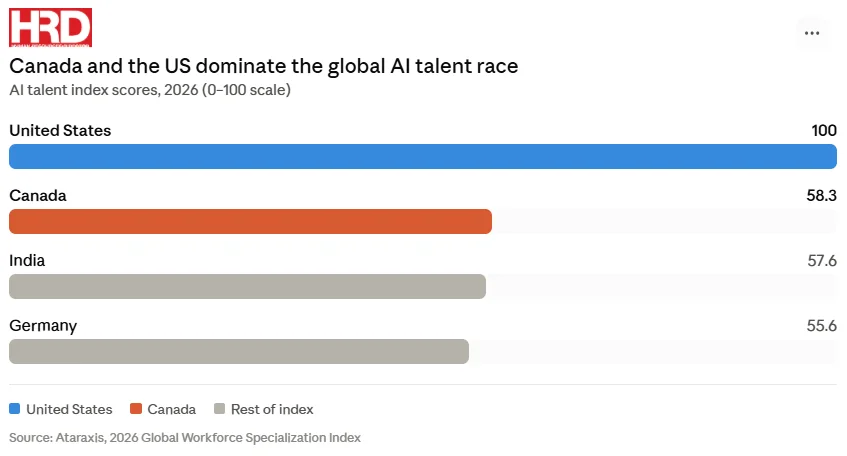
Density gives Canada its edge
The index covers 32 countries and six professional fields. It weights workforce capacity at 40%, capacity relative to population at 35%, and readiness to deliver services at 25%. Those measures reward both the size of a skilled workforce and how concentrated that expertise is relative to the broader population. The framework helps explain why a country can have a large pool of specialists without ranking as highly as a smaller, denser one.
India, for example, has a higher absolute AI capacity score than Canada—81.9 versus 54.7—but lands just behind in the overall ranking. Canada’s capacity-density score is 39.9, compared with India’s 6.6; both receive a service-readiness score of 90. The result points to a specific Canadian strength: talent density. It doesn’t establish that Canadian businesses are using AI more effectively, since the index measures workforce specialization and readiness rather than the extent of adoption by employers.
Separate figures from CBRE’s 2026 Scoring Tech Talent report point to rapid growth across North America: AI-skilled tech workers in the US and Canada rose 45% year over year to 751,000 by mid-2026. AI-specialty talent accounts for 37% of the US total. In Canada, 60% is concentrated in Toronto, Montreal and Vancouver. That concentration gives employers access to established pools of expertise, but it also means recruiting pressure is likely to be felt most directly in those urban markets.
Compensation adds another pressure point for Canadian employers. CBRE puts the tech wage premium at 8% above the national average in Canada, compared with 15% in the US. The smaller premium may look like a cost advantage, but it doesn’t remove competition for specialists whose skills are in demand on both sides of the border. For employers, the practical challenge is retaining expertise while translating it into work that improves operations.
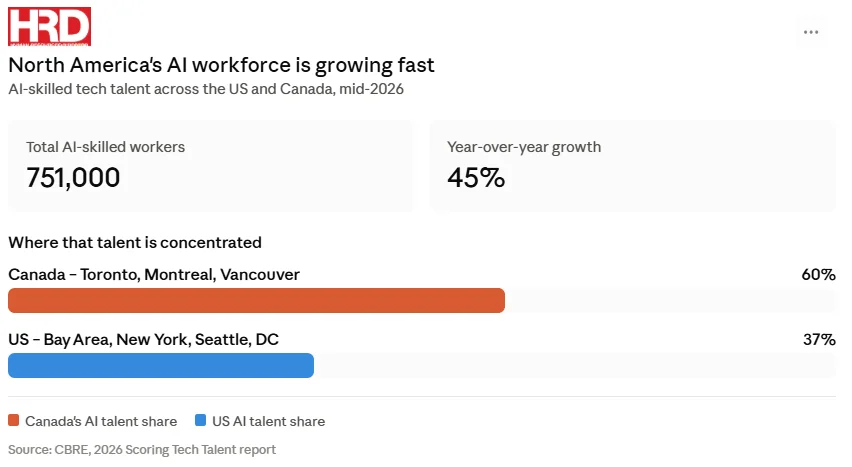
Talent is concentrated, adoption is not widespread
Canada’s research base includes Mila, the Vector Institute and the Alberta Machine Intelligence Institute (Amii). In July 2026, Amii received a C$50 million provincial commitment over five years. These institutions add depth to the country’s AI ecosystem, while the concentration of talent in three cities makes those markets especially competitive for recruiters. This is more significant than it looks: a national advantage can coexist with uneven access for employers outside the largest hubs.
For employers, workforce supply and workforce retention are distinct challenges. Reporting on Canada’s AI skills gap and worker confidence points to a further question: whether organisations can build the skills and confidence needed to put available expertise to work. Hiring specialists can fill technical roles, but wider adoption also depends on whether other employees understand how new tools fit into their jobs. If you’re working in this space, the distinction matters: a strong hiring market doesn’t automatically produce an AI capable organisation.
Adoption figures underline that gap. Statistics Canada’s Canadian Survey on Business Conditions found that 19.2% of businesses had used AI to produce goods or deliver services in the 12 months before the survey, conducted from April to May 2026. That’s up from 6.1% in 2024, showing a clear increase in reported use. Yet most businesses still hadn’t adopted AI for those purposes. The figures describe use in producing goods or delivering services, so they shouldn’t be read as a measure of every possible workplace application.
Deployment depends on organisational readiness
Patrick Poulin, president and managing director of Randstad Canada in Montreal, described skilled professionals as the main constraint on adoption. “In 2026, the main constraint on AI adoption will not be tools or investment — but the availability of skilled professionals who can implement these systems at scale,” he said. His view puts workforce capacity at the centre of the implementation question. Access to technology may start a project; skilled people are needed to connect it to business processes and sustain its use.
Rob Wilmot, general manager of IBM Consulting Canada in Toronto, offered a related view in February 2026, saying organisations were entering the year “not because the economy is predictable, but because leaders are betting on AI as a long-term growth engine.” The question for employers is whether that commitment is matched by the people and internal coordination needed to deliver. Ambition alone doesn’t resolve gaps between technical teams, managers and the workers expected to use new systems. And yet, that coordination can determine whether a project moves beyond a pilot.
An IBM study with Oxford Economics found HR is left out of AI strategy decisions at 37% of Canadian firms. That exclusion may make it harder to connect hiring, workforce planning and implementation, since those decisions shape how roles and skills change as technology is introduced. (And this is the part most people overlook.) The five workforce transformation priorities in Canada’s national AI strategy offer a frame for that work. A framework can help organise the discussion, but employers still have to turn priorities into decisions about people and processes.
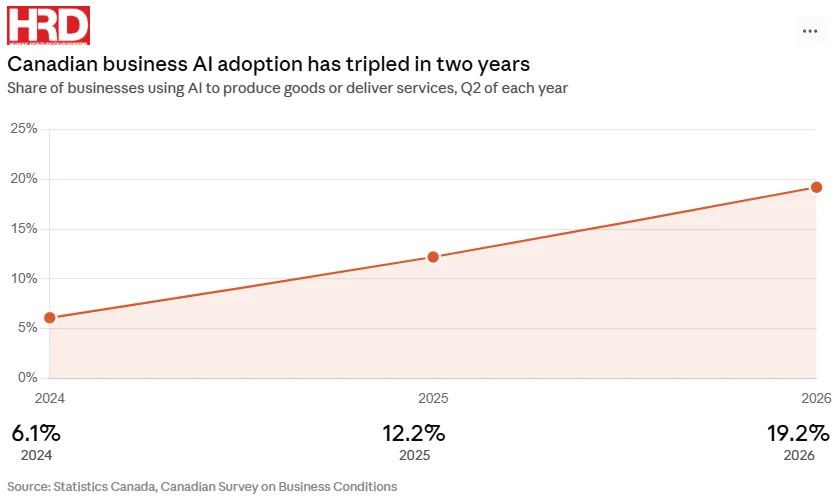
What the ranking means for employers
Canada’s ranking confirms that specialist talent is available at meaningful scale, particularly in its largest tech hubs. The adoption figures show that availability and use remain separate measures, and the gap between them is where employers’ execution will be tested. A concentrated pool can support ambitious projects, but it also raises questions about access, recruitment and the ability to spread skills through an organisation.
Here’s the thing: the ranking is a starting point, not a verdict on business performance. The next measure to watch is whether more businesses can turn concentrated expertise into wider operational use, while giving workers the skills and confidence to take part. Progress will depend on implementation. Slowly, and unevenly.