Northeast Heating Oil Bills Forecast to Rise 21% This Winter
Oil heat is set to outpace the other winter fuel bills
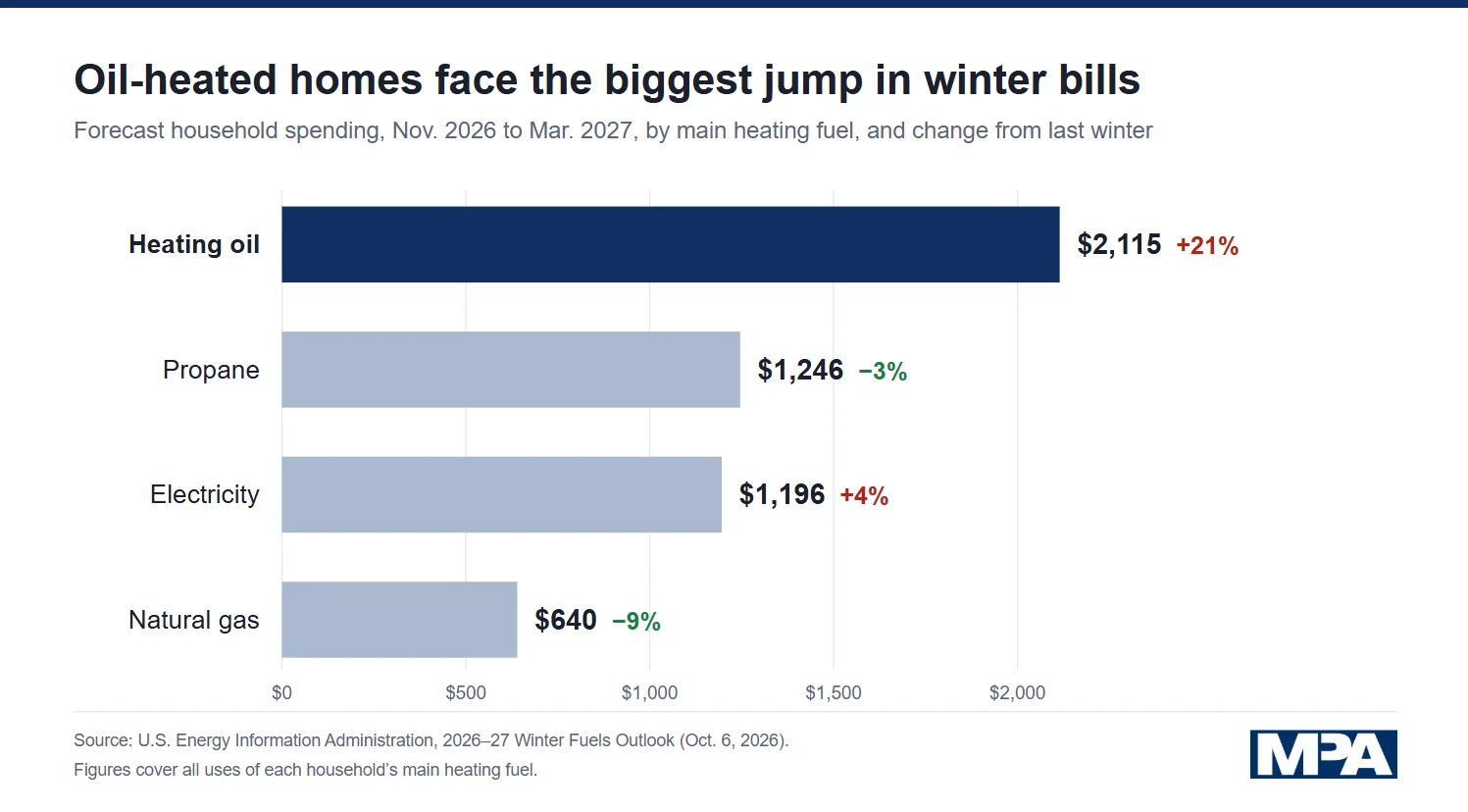
For households that heat with oil, the price increase is doing more damage than a milder winter can repair. The average oil-heated home is forecast to spend $2,115 from November through March, 21% more than last winter. That’s the steepest increase among the four main fuels tracked by the U.S. Energy Information Administration (EIA), and most of the households facing it are in the Northeast.
Matthew Sellers | 08 Oct 2026
About 4.1 million U.S. households rely on heating oil. The EIA expects the fuel to average $5.26 a gallon between November and March—34% above last winter’s price—according to its 2026–27 Winter Fuels Outlook, published Oct. 6. A milder forecast for the Northeast could trim household use to about 402 gallons, a 9% drop, FinChannel reported. That savings won’t keep pace with the higher price. The EIA’s forecast still points to a substantially higher seasonal bill.
Read next: Hidden costs can spike homeownership burden by more than $21,000: report
Tight fuel supplies are pushing costs higher
Here’s the thing: heating oil and diesel are essentially the same fuel, so pressure on diesel supply reaches homes as well as truck fleets. The EIA says reduced refinery output has tightened global distillate supply, raising international prices. Imports have become more expensive, while U.S. exports have drawn more fuel out of domestic inventories: distillate exports rose 20% in the first seven months of 2026, with much of that volume going to Europe. U.S. inventories are expected to sit about 11% below their five-year average this quarter.
EIA Administrator Tristan Abbey said oil-heat households “face higher prices because distillate markets remain tight,” Oklahoma Energy Today reported. Refinery outages in Russia and the Middle East, alongside reduced Chinese fuel exports, have added pressure. Some analysts expect prices to remain elevated into 2027, according to CNBC.
Crude is an even larger part of the cost story. Disrupted flows through the Strait of Hormuz have kept oil expensive for much of the year. The EIA now forecasts Brent crude at an average $105 a barrel in the fourth quarter, $14 above its estimate from a month earlier, Yahoo Finance reported. The agency expects the benchmark to ease to about $84 in 2027, according to FinChannel.
Weather could shift the final bill in either direction. Forecasters expect El Niño conditions, and the EIA says temperatures may swing more widely than its baseline assumes. A colder-than-expected January would mean more fuel burned and higher costs. The agency’s next monthly update is scheduled for Nov. 10.
Read next: Treasury yields breach 21-year high
Other fuels show a different picture
Oil is the outlier in the EIA’s winter outlook. Natural gas and propane households are forecast to spend less, while electricity users face a modest increase. The figures cover household use of each primary fuel, not space heating alone, so the electricity estimate includes other uses too, FinChannel noted.
| Primary heating fuel | Forecast winter spend (Nov–Mar) | Change vs. last winter |
|---|---|---|
| Heating oil | $2,115 | +21% |
| Propane | $1,246 | −3% |
| Electricity | $1,196 | +4% |
| Natural gas | $640 | −9% |
Source: EIA 2026–27 Winter Fuels Outlook, as reported by CNBC.
The Northeast carries most of the exposure
Only around 3% of U.S. homes use heating oil, but the national average conceals a sharp regional concentration. Roughly 3.4 million of the country’s 4.1 million oil-heated households—about 82%—are in the Northeast, according to federal figures cited by CNBC.
State surveys show how quickly local prices have climbed. Massachusetts dealers averaged $6.12 a gallon on Oct. 5, compared with $3.53 a year earlier, according to the state’s weekly price survey. Maine’s Department of Energy Resources reported a $5.96 statewide average on Sept. 28, up about 79% from $3.33 in late September last year.
There’s also a wide gap between forecasts. The National Energy Assistance Directors Association (NEADA), which represents state officials who administer federal heating aid, estimated in late September that an oil-heated household would spend about $2,627 this winter, up roughly 50% from $1,749 last year, Money Talks News reported. NEADA’s estimate rose from about $1,700 in July, when it was projecting winter costs, to closer to $2,300 by mid-September, according to ConsumerAffairs. The EIA and NEADA estimates differ considerably; the available figures don’t fully explain the gap.
Even within Massachusetts, the price depends on the dealer. The cheapest 10% charged $5.69 a gallon or less in the state survey, while the most expensive 10% charged at least $6.61. On a typical 150-gallon delivery, that 92-cent difference amounts to about $140. “Shopping around does pay off,” NEADA executive director Mark Wolfe told CNBC.
Read next: These states are making homeownership nearly impossible in 2026
What the higher bill means for borrowers
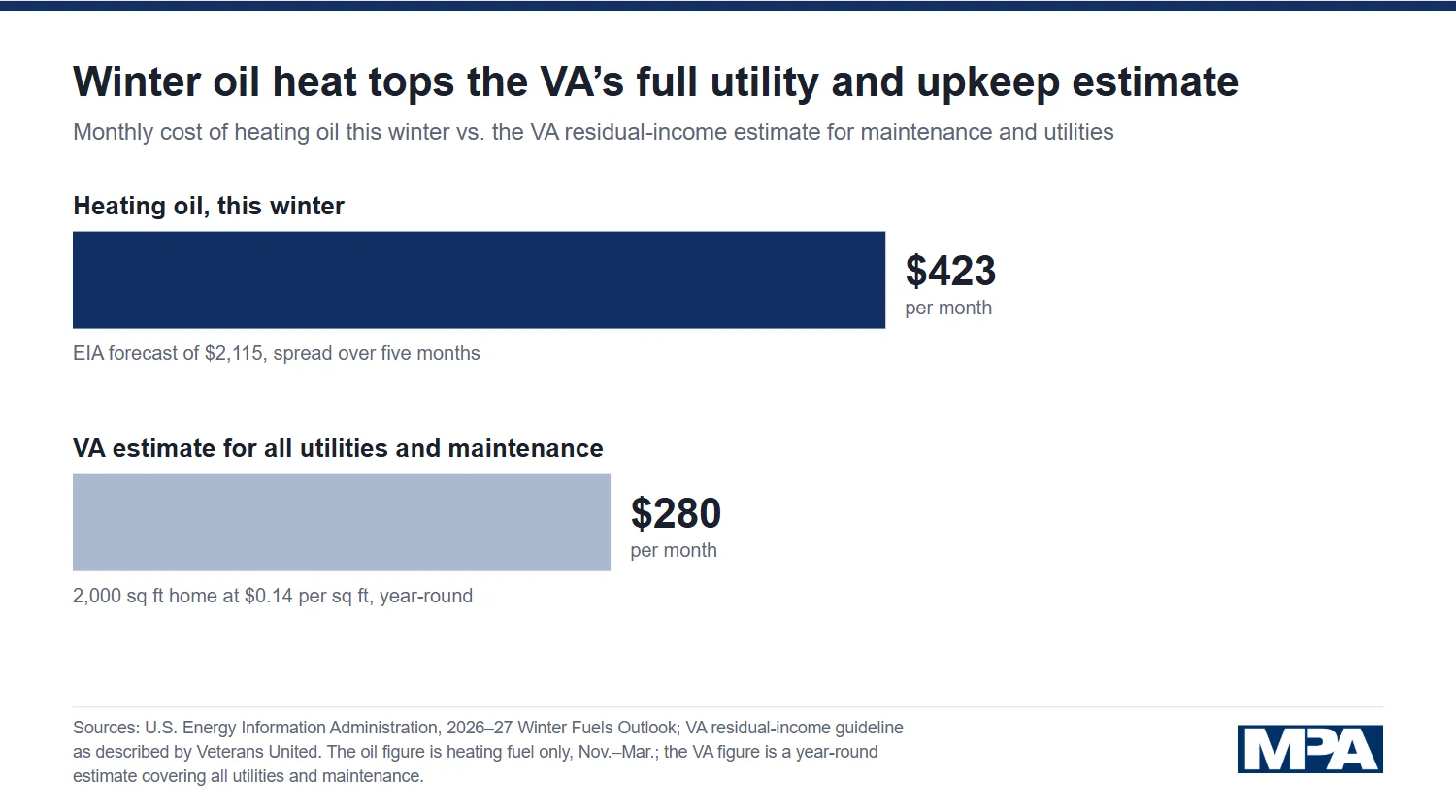
Heating costs don’t appear on a loan estimate, and standard debt-to-income calculations leave utilities out. But the money still comes from the same paycheck as the mortgage. At the EIA’s $2,115 seasonal estimate, oil heat averages about $423 a month across the five-month winter period.
The VA’s residual-income test is one of the few underwriting measures that accounts for utilities at all. It uses a flat allowance of $0.14 per square foot for maintenance and utilities combined, according to Veterans United. For a 2,000-square-foot house, that works out to about $280 a month year-round, whatever the fuel. An oil-heated home’s January bill could run well above that amount.
That squeeze lands alongside other rising ownership expenses. An Insurify analysis found hidden homeownership costs can exceed $21,000 a year, with utilities among the largest expenses. The share of owners who are cost-burdened has reached a decade high, while homeowners have also faced record-high property insurance costs. For a household already close to its limit, a 21% rise in heating fuel can change the monthly math.
Read next: 71% of homeowners say insurance costs are up, and exec warns buyers are being squeezed out
Oil prices are adding pressure to mortgage rates through the bond market. The 10-year Treasury yield recently hit its highest level since 2002, as energy costs fed inflation concerns. With crude hovering near $100 a barrel, a swift mortgage-rate decline looks doubtful. Cotality chief economist Selma Hepp sees some room for rates to ease, though, in her recent outlook. The path is uncertain, and borrowers shouldn’t count on cheaper financing soon.
Heating assistance faces a funding test
For households struggling with energy bills, the federal Low Income Home Energy Assistance Program (LIHEAP) may help. Eligibility and benefit amounts differ by state. Borrowers can locate a nearby office at energyhelp.us or call the National Energy Assistance Referral line at 1-866-674-6327.
The bigger question is whether LIHEAP will have enough funding. NEADA sought an additional $3 billion from Congress in July to address the oil price spike. Separately, 19 Senate Democrats and Sen. Bernie Sanders of Vermont urged Health and Human Services Secretary Robert F. Kennedy Jr. to request at least $3 billion beyond the roughly $4 billion already allocated, Common Dreams reported.
That request collides with the administration’s fiscal 2027 budget, which proposed eliminating LIHEAP funding for the sixth time. Lawmakers from both parties have indicated they’ll oppose the cut, as Congress has in previous years. The money remains uncertain until that dispute is settled.
Households can also take steps to limit consumption. The Department of Energy says turning the thermostat down for about eight hours a day while sleeping or away can cut annual heating and cooling bills by as much as 10%, according to its fall and winter energy-saving guidance. Sealing drafts around doors and windows and servicing heating equipment are two other recommendations. For borrowers, those measures may ease utility costs, but they don’t resolve the larger uncertainty over federal aid or mortgage rates.